



Solutions
Morlion / Solutions
Material solutions.
Defined by your application.
Materials selected around the application. Explore alumina fibers, technical textiles, ceramic precursors and thermal barriers for demanding industrial environments.
Explore solutions 
Explore applications
Find the right starting point.
01Thermal & electrical protection
Industrial Thermal Insulation
Select insulation around the furnace, not just the highest temperature on a data sheet. Morlion supplies alumina fiber and aerogel formats for thermal barriers, linings and seals.
ExploreAutomotive Exhaust Systems
Polycrystalline alumina fiber materials can provide thermal isolation and support around exhaust-treatment components. The mounting system must be designed for the substrate, canning gap and duty cycle.
ExploreBattery Thermal Barriers
Thin alumina fiber sheets offer a starting point for thermal barriers between cells, modules and adjacent structures. Successful protection depends on the complete assembly and its tested exposure conditions.
ExploreElectrical and Thermal Insulation
Combine ceramic textile forms with the geometry of cables, thermocouples, pipelines and hot equipment.
Explore02Composites & precision components
Ceramic and Metal Matrix Composites
Continuous alumina fibers provide reinforcement options for oxide ceramic and metal matrix composite development. Fiber composition, interface behavior and processing route must be considered together.
ExplorePrecision Ceramic Components
Combine ceramic material selection with a forming and finishing route suited to the part. Morlion’s Chinese site describes precision ceramic, metal and composite processing for industrial components.
ExplorePrecision Metal Components
Select a manufacturing route around the part geometry, material and production volume.
ExploreComposite Component Manufacturing
Morlion’s Chinese site describes machining and molding routes for polymer and fiber-reinforced composite components.
Explore03Materials for process industries
Glass and Semiconductor Processing
Alumina textiles and high-purity ceramic feedstocks address thermal insulation, electrical isolation and material-processing needs in glass and semiconductor equipment.
ExploreMolten Metal Filtration
Alumina fiber textiles offer a material route for filtration of aluminum, copper and other non-ferrous molten alloys.
ExploreCeramic Coatings and Catalyst Supports
Alumina powders, sols and slurries support the development of refractory coatings, ceramic surfaces and catalyst carriers.
ExploreApplication planning
Define the conditions. Then select the material.
Start with the operating conditions
Temperature is only one part of a material specification. Atmosphere, mechanical loading, available space, chemical exposure and the intended manufacturing process help determine the right grade and product form.
Find a material route for your industry
Alumina materials serve different roles: retaining heat, insulating electrical components, supporting exhaust-treatment substrates and reinforcing composites. Begin with the function of the finished part, then select the fiber form and grade.
| Application | Material formats to explore | Define for the project |
|---|---|---|
| Industrial furnaces and kilns | Blankets, felt, paper and fabricated textile seals | Lining location, cycling, joints and available thickness |
| Vehicle exhaust treatment | Fiber mats and insulating layers | Substrate support, canning gap and vibration |
| Battery and energy-storage systems | Thin fiber-paper barriers and layered insulation | Space, compression, electrical isolation and thermal exposure |
| Cables and hot equipment | Braided sleeves, tapes and fabric covers | Installed geometry, abrasion and electrical requirements |
| Filtration and process equipment | Fiber media, ceramic feedstocks and protective coatings | Gas or melt chemistry, flow and cleaning conditions |
From raw fiber to a working assembly
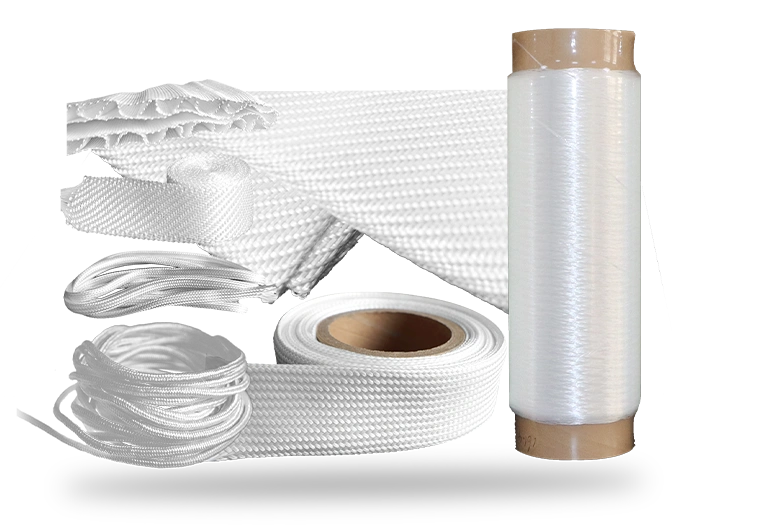
Continuous yarn can be woven or braided around a component. Short fiber can be converted into blankets, mats and paper. A finished assembly may also include coatings, facings, seams or attachment hardware, each with its own processing and service limits.
Start an application review
Send a drawing or description of the part, the normal and peak temperatures, surrounding chemicals, mechanical loads and expected production quantity. Include the tests and documentation your team needs so material selection and sample evaluation can follow the same requirements.
Start a conversation
Talk to Morlion
Share your application, material requirements and the documentation needed for your project.